Author: admin

  • AI in Business 2026: Tactical Playbook

    AI in Business 2026: Tactical Playbook

    By 2026, embracing AI won’t just be an option; it’ll be a necessity. Businesses that envision AI as the beating heart of their operations—not just a plug-and-play tool—will edge out the competition. It’s time to stop thinking about AI as a detached assistant and start incorporating it as the operational nucleus of your business. Let’s dive into how this transformation can change your game.

    Rethink Your Workflow: Outcome-Centric AI Integration

    Focusing on isolated task automation is old news. To stand out in the AI-driven arena of 2026, you need to shift your strategy toward crafting AI workflows that are outcome-centric. By letting AI manage complex processes from start to finish, you unlock new efficiency heights. Imagine a supply chain system where AI orchestrates production schedules, resource allocations, and logistics dynamically. Or consider customer service driven by AI, which doesn’t just handle inquiries but learns customer preferences, predicts issues, and provides proactive solutions. These workflows aren’t about replacing tasks; they’re about owning outcomes and elevating your business’s core operations.

    Build a Centralized AI Orchestration Layer

    Fragmented tool ecosystems? Forget them if you want to leap ahead by 2026. You need an integrated AI orchestration layer—a brain that combines models, data, and governance into a seamless unit. This means establishing a central hub for all AI-related activities, allowing for uniform rules and easy scalability. Step one involves auditing your existing tools and identifying overlap and inefficiencies. Step two is creating a unified data architecture that enables seamless model interaction. This centralized system not only streamlines operations but also facilitates innovation, freeing your team from the clutter of disjointed solutions. Through this centralization, you’ll not only save time but also eliminate the inefficiencies that can hobble progress.

    Restructure Human Roles for Strategic Impact

    As AI takes on more of the mundane, restructuring human roles around strategy becomes paramount. Humans should transition from operators to strategists—visionaries steering the AI ships. This shift doesn’t mean eliminating human input but redirecting it toward areas where it matters most, such as setting intent and ensuring oversight. In this setup, humans drive the high-stakes decisions, while AI handles execution and repetition. Picture a marketing strategist who devises campaigns, while AI tests variations and reports back with insights. People create and innovate; AI executes and optimizes. This is the collaboration that will define successful businesses in 2026.

    Outpace the Competition with Organizational Redesign

    Organizational inertia can be a killer. Those clinging to outdated hierarchies will find themselves outmaneuvered by agile competitors. Embracing a redesign aimed at seamless AI integration provides a hard-to-beat advantage. The businesses that have already adopted AI restructuring are finding noticeable gains in speed and adaptability. Consider the retail giant that leveraged AI across procurement, inventory, and customer analytics—transformation at this scale spurs growth and leaves traditional structures in the dust. When AI becomes the backbone of your organization, a competitive edge isn’t just a bonus—it’s the expectation.

    The Inevitable Decline of Coordination Roles

    AI will inevitably shrink the middle management tier by shouldering planning and task management. Companies with flatter hierarchies are poised to benefit significantly from AI’s rise. Without layers of coordination roles, these businesses can pivot faster and deliver results with less managerial drag. Picture a boutique agency where AI manages client communications, freeing up the creative director to focus on high-impact creative decisions. This cultural shift isn’t easy—it requires buy-in and belief in autonomy and empowerment within teams. But those willing to tread this path will find rewards in agility and innovation.

    Measure Success: Business Outcomes Over Technical Metrics

    Don’t measure AI’s impact by how many algorithms you’ve deployed. Focus instead on outcomes—revenue growth, cycle time reduction, error minimization. Consider the case of a tech firm that used AI to slash product development time in half, leading to a 20% increase in market share. Contrast this with companies bogged down in AI technical minutiae and realizing little value as a result. It’s the business outcomes, not technical statistics, that signal real success. Look beyond the flashy dashboards, and ask what AI is truly doing for your bottom line.

    Conclusion

    AI in 2026 isn’t just about adoption—it’s about redesign. Transform your business operations, strip away inefficiencies, and elevate human roles. The goal is clear: become the disruptor, not the disrupted. Embrace AI as the operating system of your business, and you’ll wield the true firepower to rise from the trenches as a leader in the digital battlefield.

  • Master Time-Efficient Blogging Side Hustles

    Master Time-Efficient Blogging Side Hustles

    Whoever crafted the term “side hustle” probably envisioned passionate souls channeling free time into dunking basketballs while minting cash. But reality writes a starkly different story. Today, it feels like if you’re not pitching over 80 hours a week into life, you’re losing in a rigged game. That can’t be our only legacy. Especially when hustling for extra income becomes a mere survival tactic rather than a pursuit of dreams. We get it—you’ve got an empire to build, but you shouldn’t shortchange life and health for it. That’s where The Blog Bunker comes in. Let’s find smart ways to cut the fat and turn your blog hustle into something sustainable and thriving.

    The Scourge of the Never-Ending Grind

    It’s hard not to become weary in the battle against time—juggling a main gig, playing catch-up with more skilled industry peers, and chipping away at your own blog ambitions. We’re not here to sugar-coat things; building a profitable blogging side project involves calculated grit. Yet, the expectation to man a ship alone on treacherous waters is where reality sharply diverges from expectations. The unease of lagging behind while others juggle successful side endeavors is a chilling thought. Here’s the kicker: burnout threatens to consume you if you insist on doing everything in the old-school sweat-and-tears style. Fortunately, we have aces up our sleeves that don’t require surrendering all your waking hours.

    Efficiency Over Exhaustion: Meet AI Firepower

    Enter AI, your not-so-secret weapon. Imagine a battalion of tireless underlings, each armed with data-driven insights, tirelessly working scouts, gathering intelligence, and strategizing your next move. How does AI do this? By optimizing workflows, streamlining your editorial output, and crafting content repurpose strategies. Harness this firepower to handle repetitive tasks—research, keyword analysis, preliminary drafts—while you focus on what you’re uniquely great at: injecting your voice and authenticity. It’s like having the same efficiency as a ten-person team without having to spend on salaries.

    Your Tactical Edge: Choose Wisely, Automate Ruthlessly

    Start where it counts. Don’t complicate; simplify. Your blog’s survival hinges on a steady stream of quality traffic. Yet, Google’s ever-evolving algorithm means what worked yesterday might fall short tomorrow. Engaging your niche audience requires precision and knowledge. That’s why sticking to actionable SEO strategies and not high-level theories is paramount.

    Content Optimization: Utilize AI to run SEO audits that might identify gaps unseen by the human eye. Tweak your post headlines, meta descriptions, and anchor texts to elevate visibility across search engines.

    Speedy Research and Content Drafting: Instead of enduring the age-old scuffle through ten different tabs, an AI assistant can summarize mountains of research into solid, refined points. Consider it as starting construction with the foundations laid.

    Editorial Scale-Up: Train AI-tools with your voice and style. Picture churning out three to five polished articles while your coffee brews. Each one branded with personal quirks, providing authenticity and driving reader connection.

    Humanize AI Instead of Fighting It

    Tech can feel cold, monotonous. Your job? Remove that robotic tone. Do a thorough comb-through where AI-generated text morphs back into human speech. This blend ensures efficiency doesn’t lead to blandness.

    Humanize through relatable anecdotes. Share chunk-sized insights and encapsulate stories within your industry that your audience, the solo content hustlers, nod along to.

    Elbow Room for Balance

    Freedom from the incessant grind. That’s the utopia we’re chasing. Wasn’t freelancing supposed to buy us more time and freedom? Ironically, we often find ourselves shackled, our time dwindling into hectic, extended work weeks. Better structures aren’t just feasible—they should be demanded. They allow room for life outside work without potential revenue spiraling into desolation.

    So, don’t fall into the trap of being perpetually on the clock. Lean into the AI-assisted mindset The Blog Bunker champions. Let’s scrap excess drudgery for time better spent on relationships and creativity. You should dictate the terms of growth, not the other way around. We’re in the trenches with you. Together, redefining the meaning of a profitable “side hustle.”

    Conclusion: Fortify Your Blogging Fortress

    The Blog Bunker isn’t just a tool; it’s your shield and spear. Avoid the pitfall of trading your life for blog success. Uplift yourself with AI firepower engineered to turn you into a lean, unfazed content machine. Because here, we understand that your side hustle is more than an income stream—it’s your patient, deliberate march toward freedom. It’s not just what you build, but how you build it. And we’re behind you every step of the way, not with empty cheerleader chants, but with pragmatic blueprints and relentless support. Are you ready to scale efficiently and rewrite your hustle story? We thought so.

  • Eliminate AI Voice: 5 Proven Editing Steps

    Eliminate AI Voice: 5 Proven Editing Steps

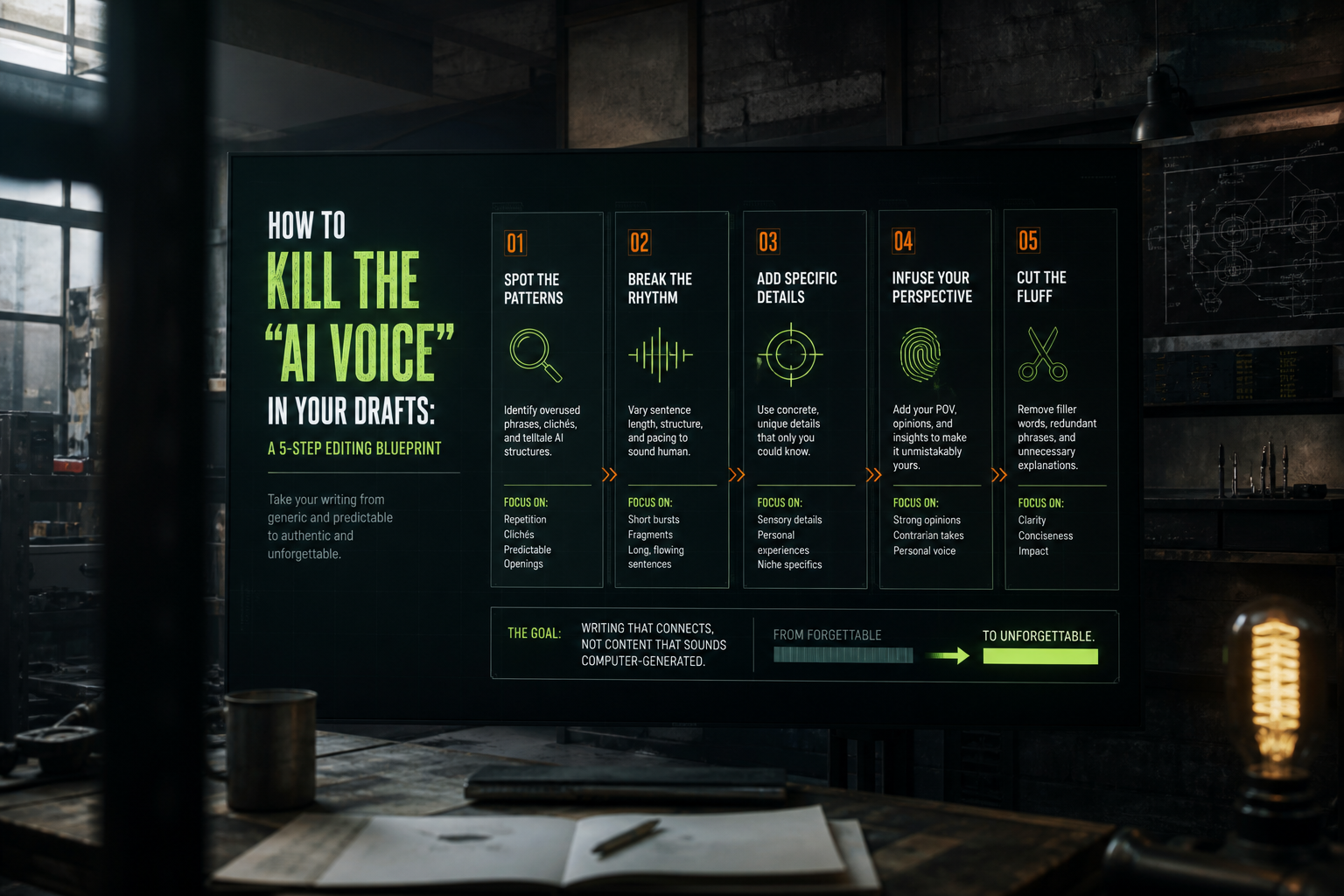
    Let’s face it—handing over the writing reins to AI has become the norm in our quest to pump out content without breaking our backs. But here’s the twist: the “AI voice” is a dead giveaway, sometimes rendering your content as flat and generic as a brochure at a dentist’s office. Independent bloggers like you can’t afford to have your hard-earned posts flagged as basic bot chatter. You need authority, raw authenticity, and a slice of humanity that lets your audience know there’s a real person behind the words.

    Here’s the battle plan: we’re diving into a no-nonsense, 5-step editing blueprint to help you strip away the generic tells and replace them with raw, human authority. Get ready—your underdog content heroism just got tactical.

    Step 1: Identify the AI Fingerprints

    First, you’ve got to become a forensic detective. AI-generated content often carries tell-tale signs: repetitive phrases, overly formal language, and the dreaded curse of monotony. Jump into your draft with a red pen (or its digital equivalent), and hunt these down. Be ruthless—the goal is to chop away any robotic residue. Remember, every phrase pulled straight from an AI often lacks the depth and flair that a human naturally entwines.

    Step 2: Infuse Personal Anecdotes

    Nothing kills AI sterility quite like personal stories. Got a quirky anecdote? Slip it in. Ever faced a challenge that forced you to step up? Share the battle scars. AI can draft grammatically sound paragraphs, but it can’t replicate the gritty texture of real experiences. These anecdotes act like breadcrumbs leading your readers deeper into your narrative and make your content not just consumable, but memorable.

    Step 3: Vary Sentence Structure

    AI, bless its silicon heart, can churn out well-formed sentences like an obedient factory line. But reading them on autopilot can bore your audience to tears. Replace uniformity with dynamism. Split long sentences with punchy bursts and interlaced tempo changes. This rhythm creates tension, anticipation, and genuine engagement—a killer trio no binary string can match.

    Step 4: Swap Jargon for Jargon-Free Authority

    SEO keywords got you buried in buzzwords? Suddenly everything’s a ‘solution.’ Strip the bluff and talk like you do with your peers—confidently and candidly. Fold in plain language without losing the edge. Describe the problem clearly, and hit them with practical steps. This shifts your content from AI-generated drivel into well-crafted authority without the corporate gloss.

    Step 5: Implement Human Editing

    Here’s the truth: no AI-generated content should reach your audience unscreened. You’re the last line of defense against soulless text. Bring in human editors—yes, that includes you. Read your draft aloud; your ears catch awkward phrasing that your eyes skim over. Fine-tune emotion and emphasis until your content cuts through the noise with sharp, decisive clarity.

    —

    Let’s remember, even with AI at our side, our mission is to make our writing feel less like an assembly line and more like the fierce, independent voice that lights fires and pulls in the troops. You need content that echoes your grit and the relentless reality of being a solo blogger. With this 5-step blueprint, you can take the raw AI output, wrangle it into shape, and turn it into a force that not only survives but thrives in the daunting digital battlefield.
    Push forward. We’re right there in the trenches with you.

  • The Field Manual 03: One Post, Every Platform

    The Field Manual 03: One Post, Every Platform

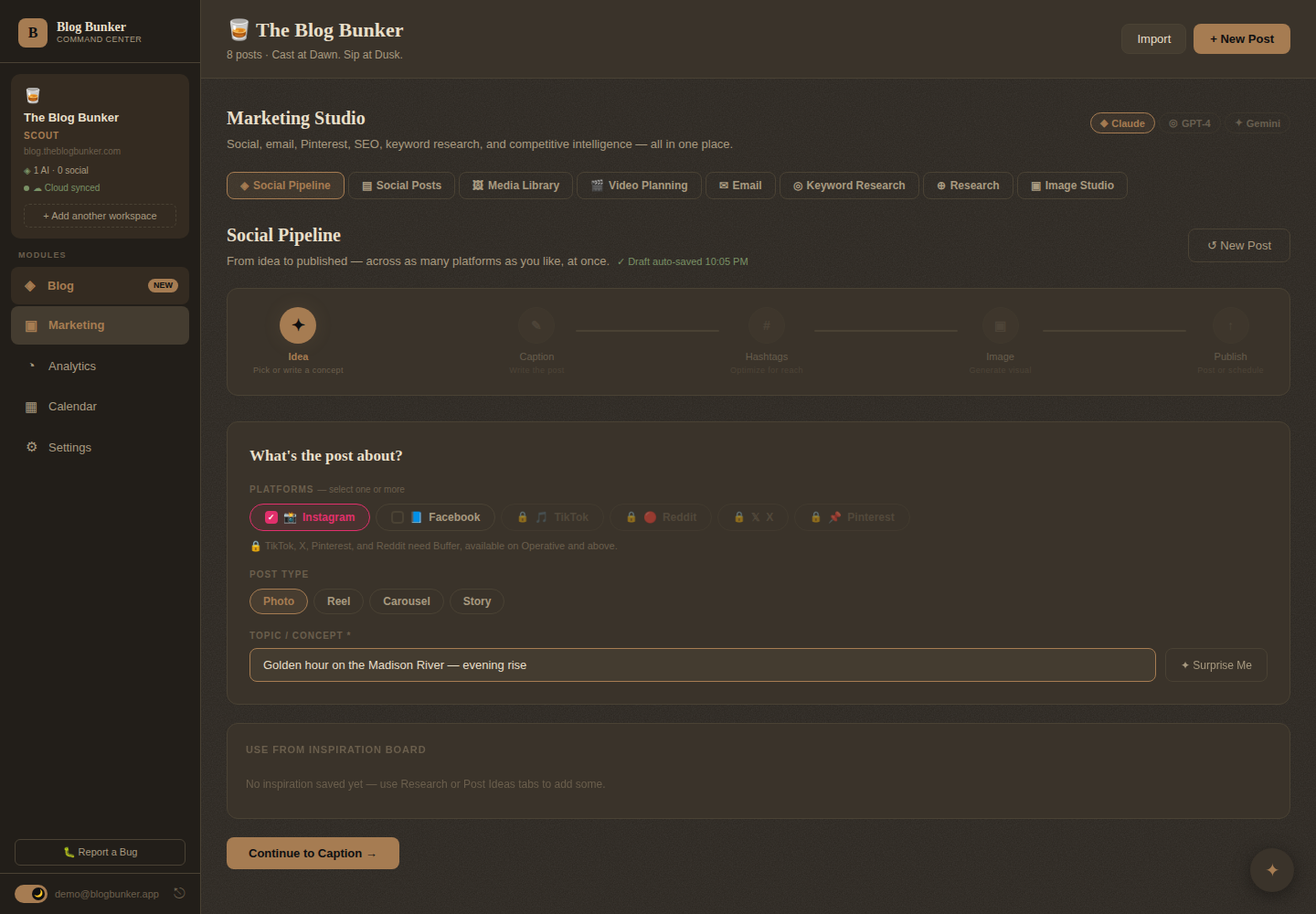
    The Social Pipeline works the same way the Article Pipeline does — one idea moves through a fixed set of stages, in order, and comes out the other side ready to go live. Five stages this time: Idea, Caption, Hashtags, Image, Publish.

    Stage 1: Idea

    Start with a concept — as short as a phrase. This can be a fresh idea, or a post you’re repurposing from something you already wrote in the Article Pipeline. Either way, pick which platform(s) you’re posting to before moving on, since everything downstream is built around that choice.

    01-idea-stage

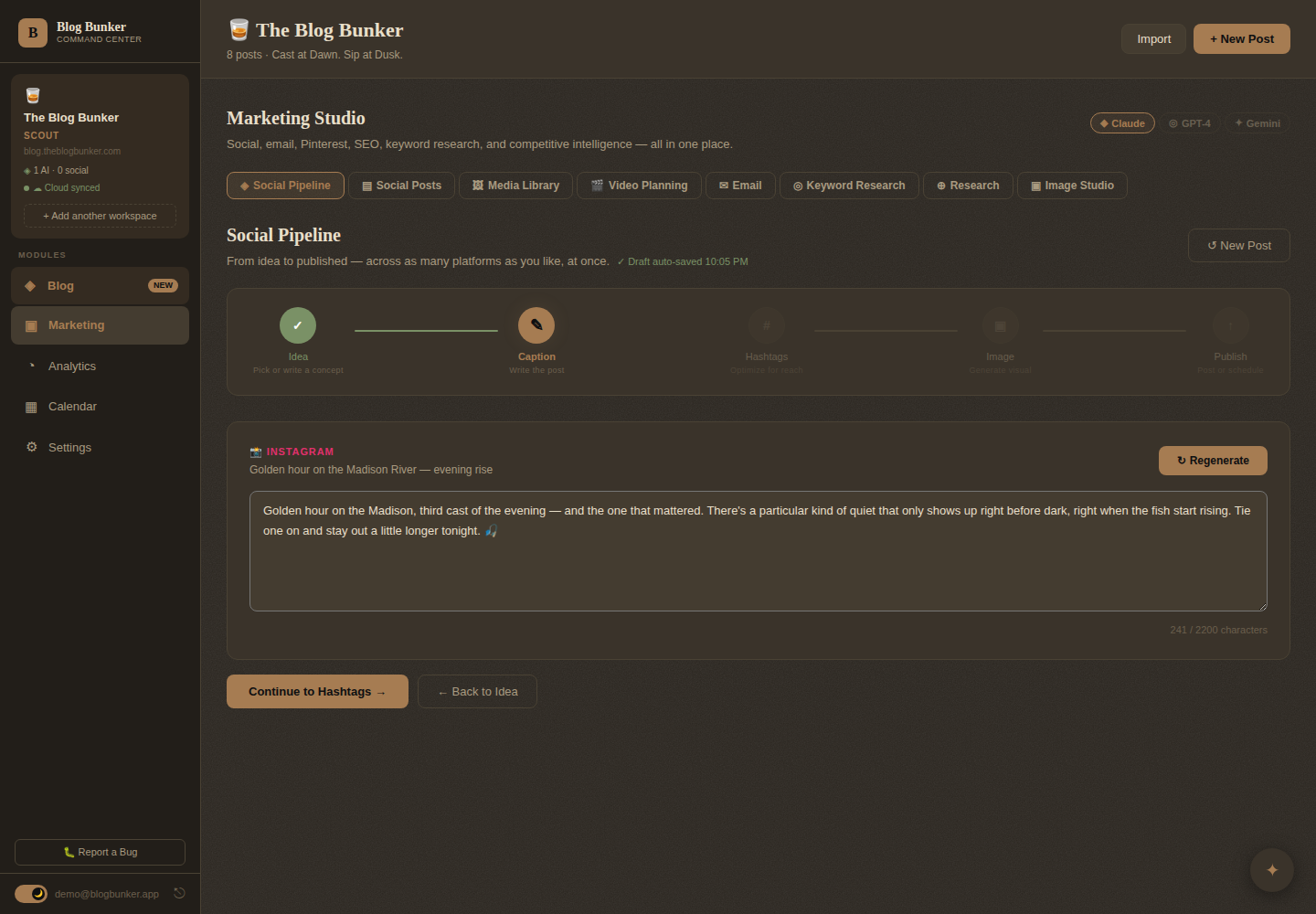
    Stage 2: Caption

    Click Write Caption and Blog Bunker drafts the post copy for you — in your Brand Guide’s voice, sized to whatever platform you picked. Not happy with it? Edit directly in the box, or regenerate. Nothing here is final until you say so.

    02-caption-stage

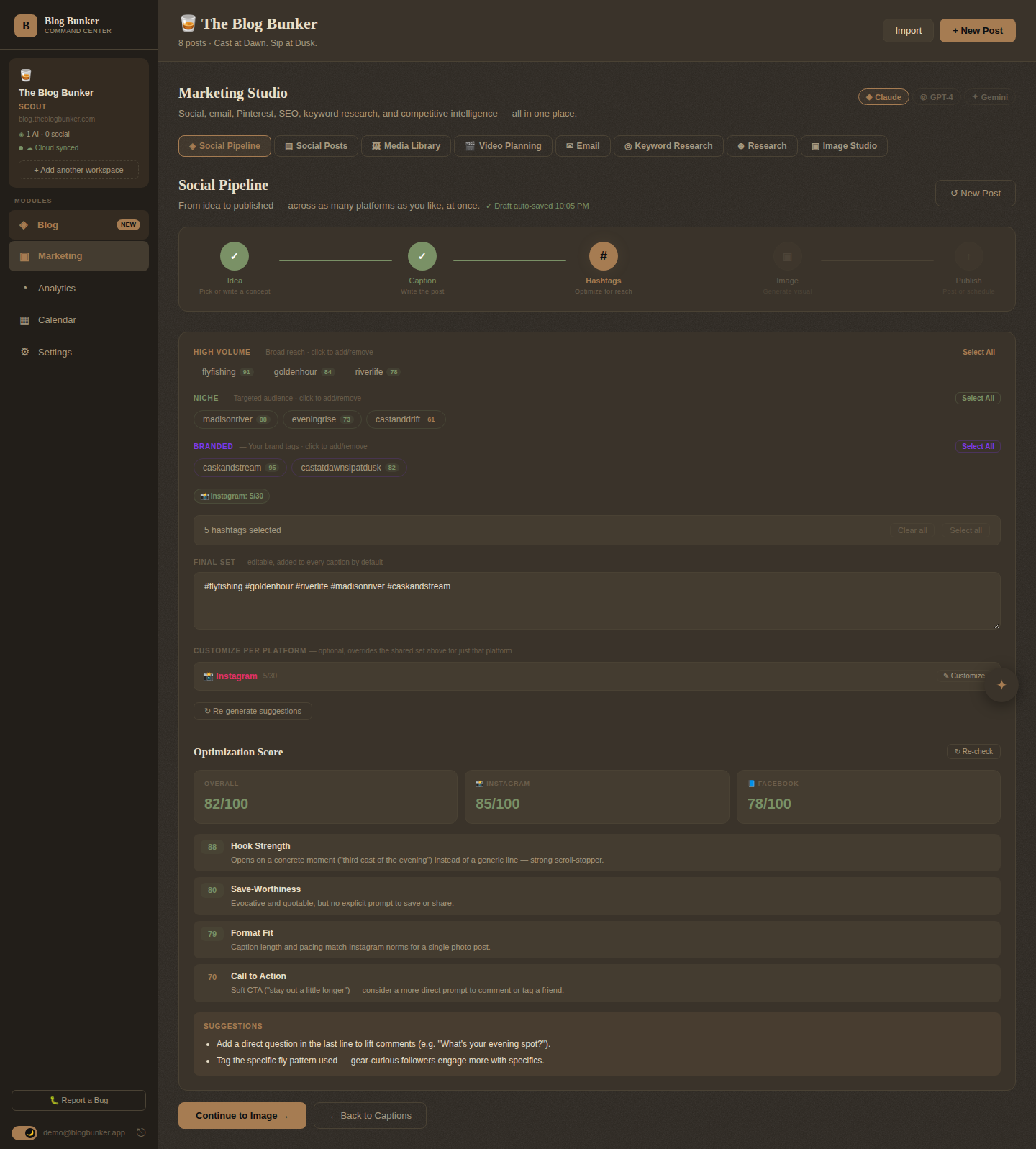
    Stage 3: Hashtags

    This stage does more than suggest tags — it scores the post itself. You’ll see an Optimization Score breaking down things like Hook Strength, Save-Worthiness, Format Fit, and Hashtag Relevance, so you know why a post is likely to perform, not just a number with no explanation. Use it to catch what’s weak before you publish, not after.

    03-hashtags-stage

    Stage 4: Image

    Generate a visual right here, or pull an existing one from your Media Library — no separate design tool required. Same as the Article Pipeline’s Enhance stage: the art gets made as part of finishing the post, not as a separate errand you do somewhere else.

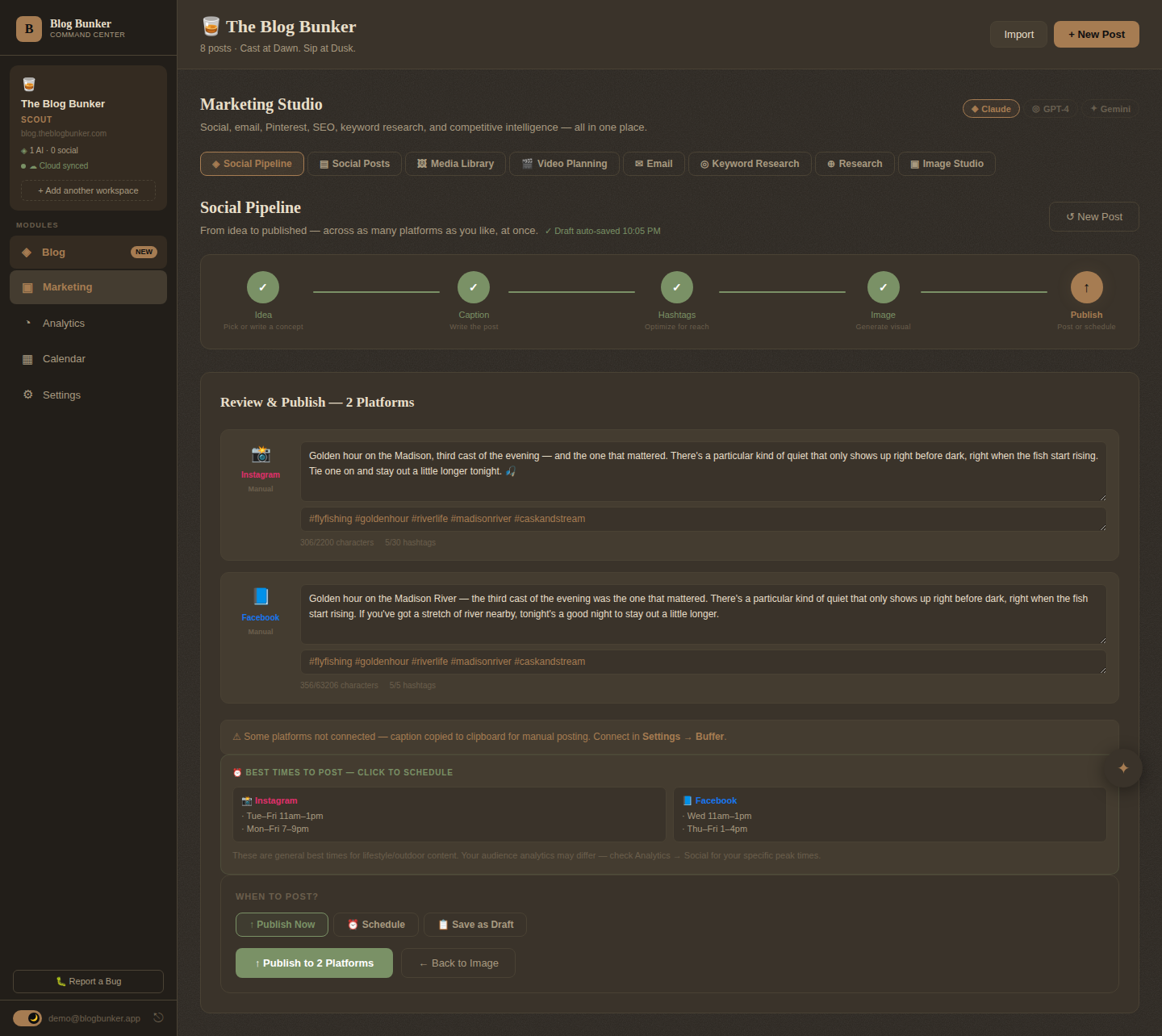
    Stage 5: Publish

    Review everything, then either post immediately or schedule it. Publishing to multiple platforms at once from a single pipeline run is the whole point of this tool — write once, adapt automatically, ship everywhere.

    04-publish-stage

    What’s next

    Once it’s live (or scheduled), it shows up on your Calendar right alongside your blog posts, and feeds into your performance numbers under Analytics.

  • Guide to Your First Blog Post Workflow

    Guide to Your First Blog Post Workflow

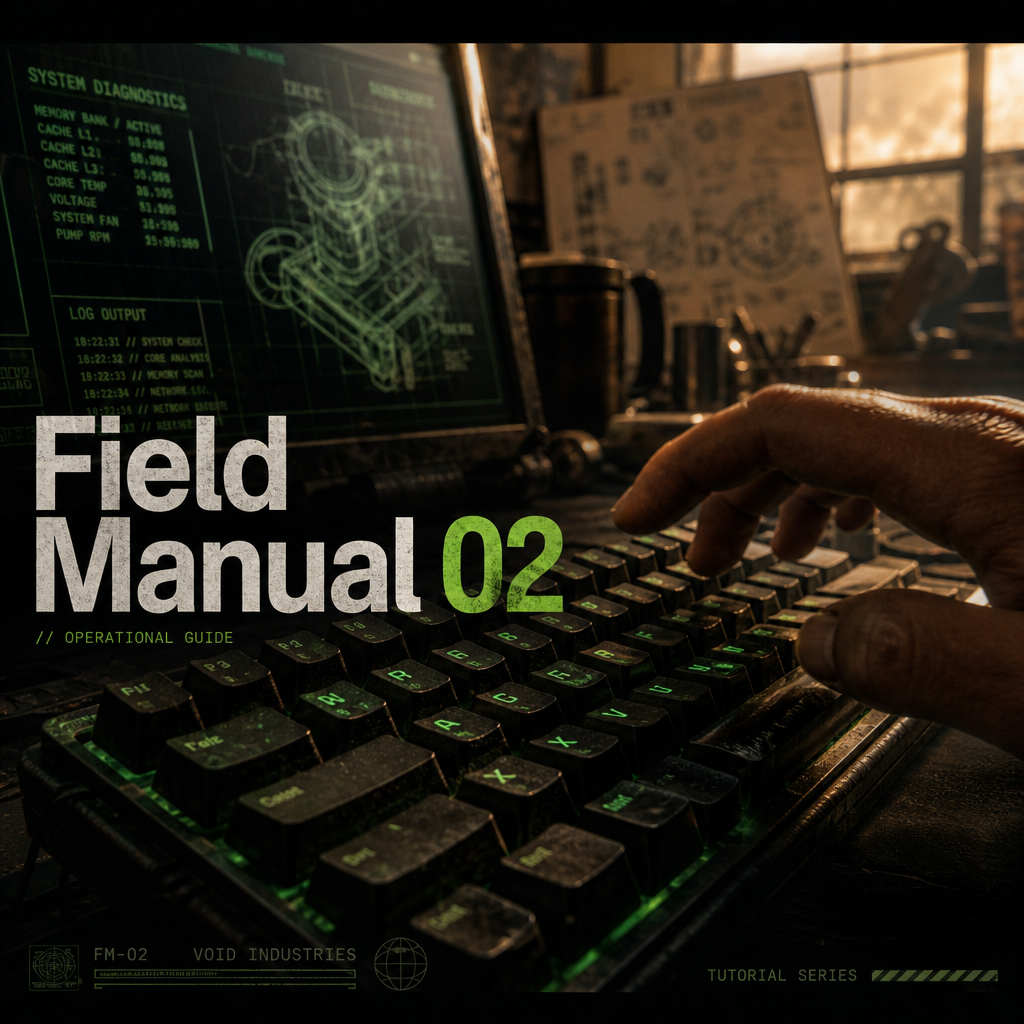
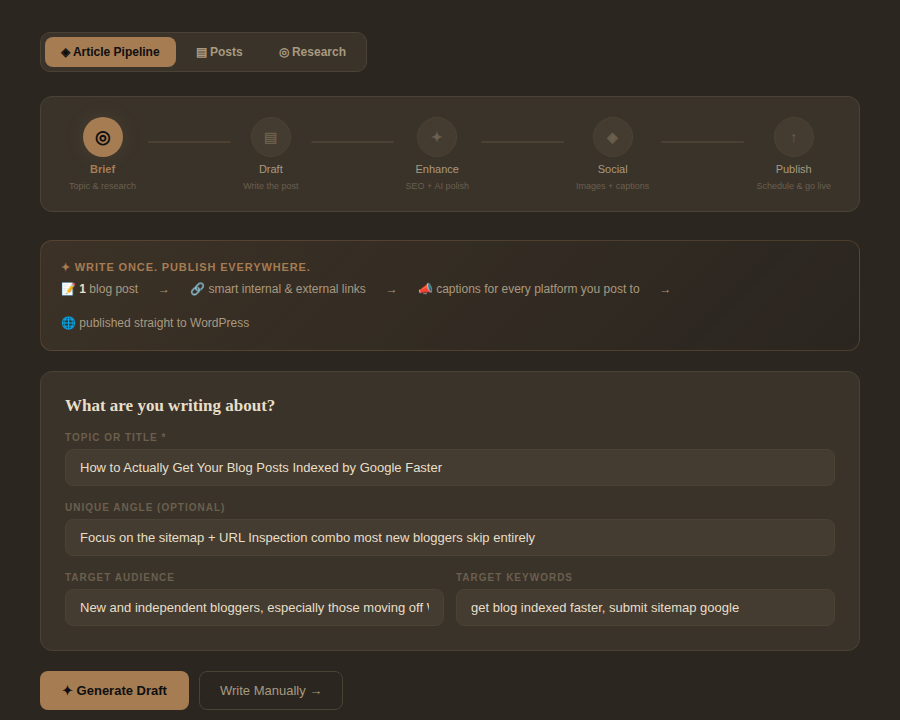
    Everything in Blog Bunker runs through one core workflow: the Article Pipeline. A post moves through five stages, in order, without you ever leaving the pipeline to hunt for a different tool. This walks through all five with your actual first post.  

    Stage 1: Brief

    This is where a post starts — a topic, an angle, what you want it to accomplish. If you’re not sure what to write about yet, this is also where the Research tools live: Competitors (what similar blogs are covering), Inspiration, and AI Ideas grounded in your own Brand Guide, not generic suggestions. blog-bunker-brief-stage-screenshot

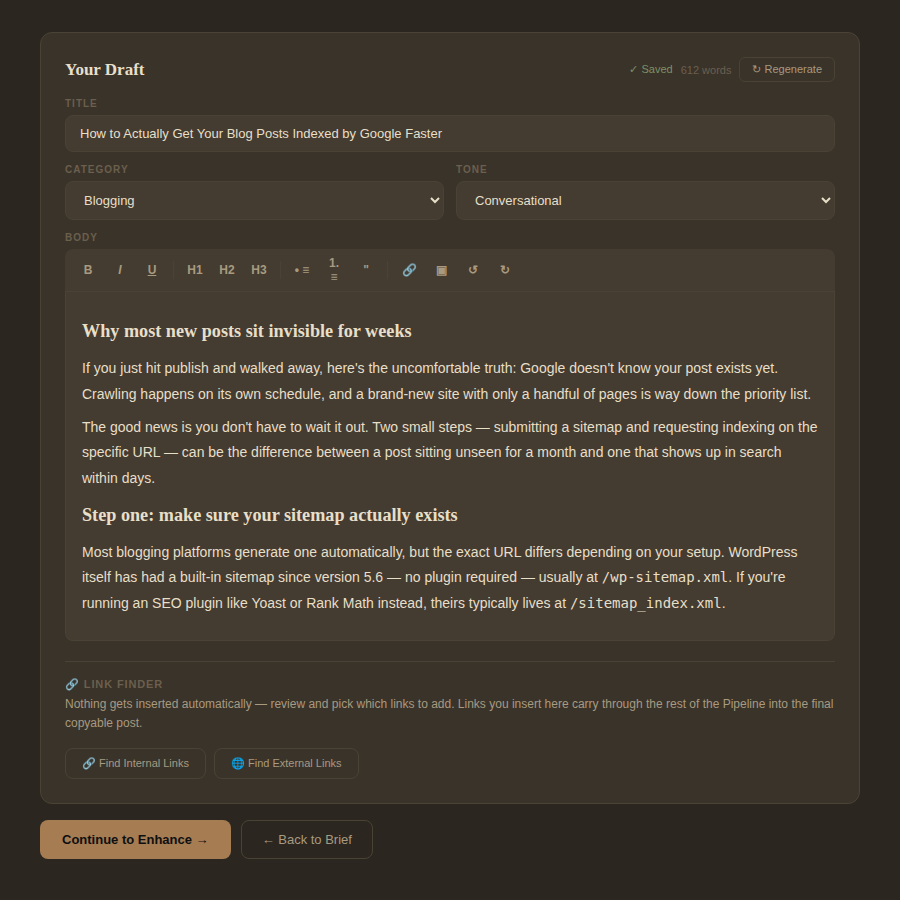
    Stage 2: Draft

    Once you’ve got a brief, this stage writes the actual post — in the voice and style you set up in your Brand Guide back in Tutorial 01. It’s a starting draft, not a finished one; expect to read it over and adjust things that don’t sound like you yet. blog-bunker-draft-stage-screenshot

    Stage 3: Enhance

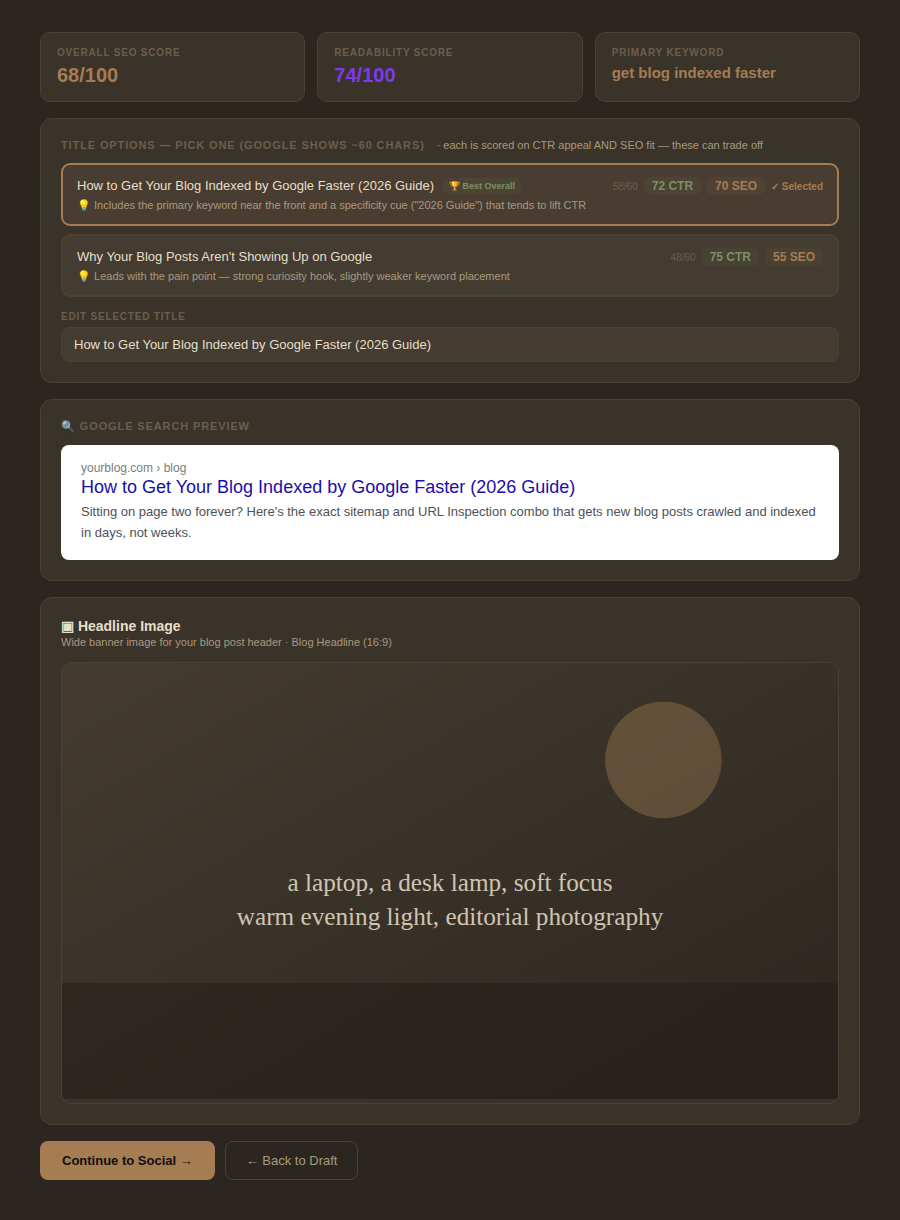
    This stage does two things at once: SEO polish (title, structure, keywords) and generates your headline image. You don’t need a separate design tool open — the art gets made right here, as part of finishing the post rather than as a separate errand afterward. blog-bunker-enhance-stage-screenshot

    Stage 4: Social

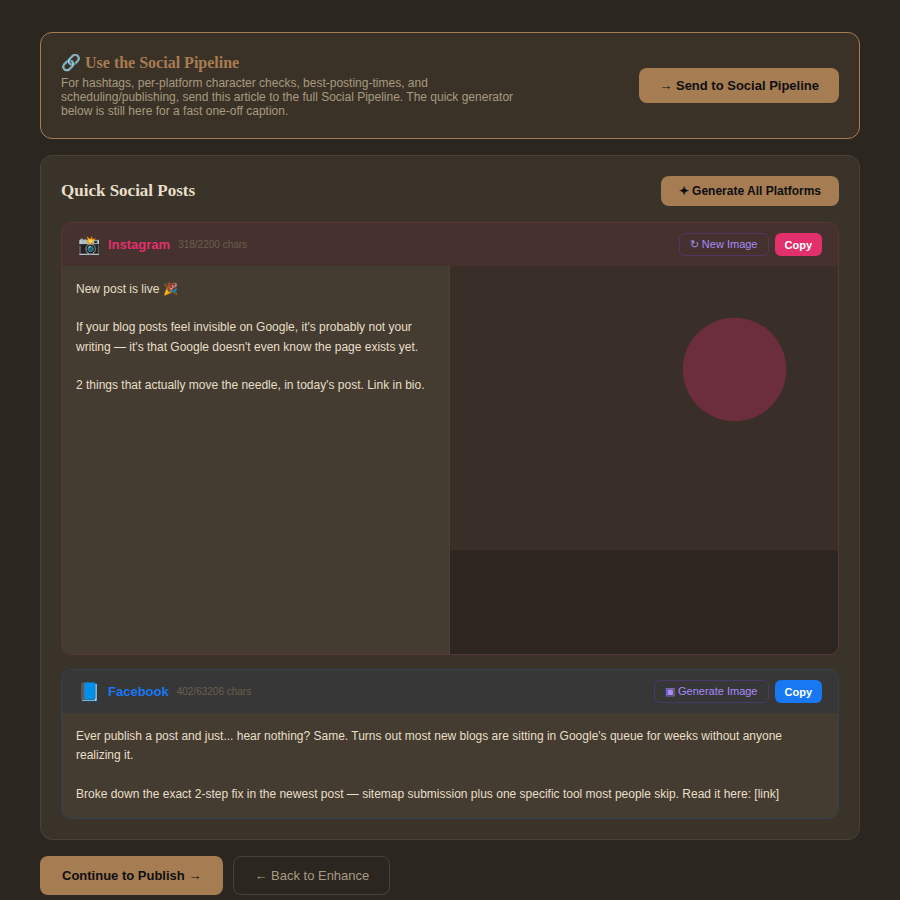
    This is where one post becomes several. Blog Bunker drafts channel-specific versions — a caption, a thread, whatever fits your connected platforms — sized to each one’s actual limits, built from the post you just finished rather than starting from scratch. blog-bunker-social-stage-screenshot

    Stage 5: Publish

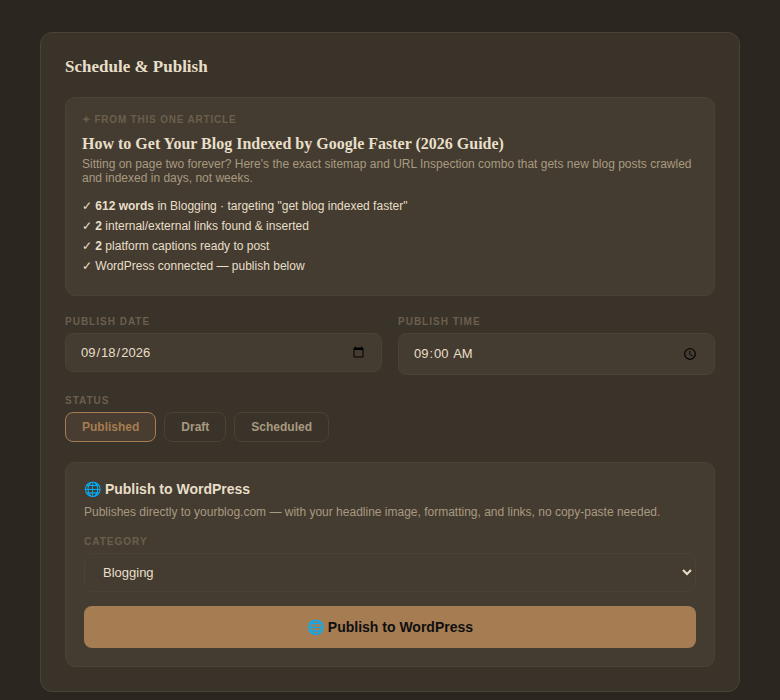
    The last stop. Review everything, then publish. If you connected WordPress in Tutorial 01, you’ll see a 🌐 Publish to WordPress button here — click it and the post goes live on your real site. Blog Bunker also remembers which WordPress post it made, so if you edit and republish later, it updates the same post instead of creating a duplicate. blog-bunker-publish-stage-screenshot

    What’s next

    Once it’s published, two places pick up automatically: your Calendar (so you can see it alongside anything scheduled for social) and your Analytics, where your Blog Health Score starts factoring in what you just shipped. That’s the whole loop — one idea, one pipeline, five stages, out the door. The next Field Manual entries cover the Social Pipeline, the Media Library, and Research tools in more depth, for when you’re ready to go past the basics.
  • Quick Start: Your Blog Bunker Setup

    Quick Start: Your Blog Bunker Setup

    New to Blog Bunker? This is the one to start with. It’ll take about five minutes, and by the end your account is ready to write and publish your first real post.

    Step 1: Sign in

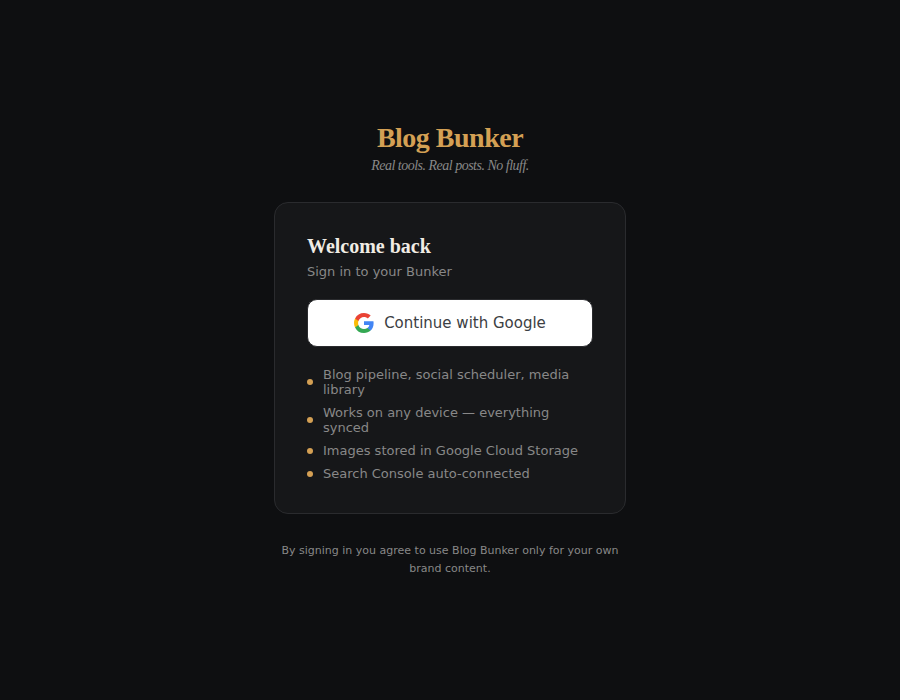
    Blog Bunker uses Google sign-in — no separate password to create or remember. Click Sign in with Google, pick the account you want tied to your blog, and you’re through the door. blog-bunker-signin-screenshot

    Step 2: Tell Blog Bunker about your blog

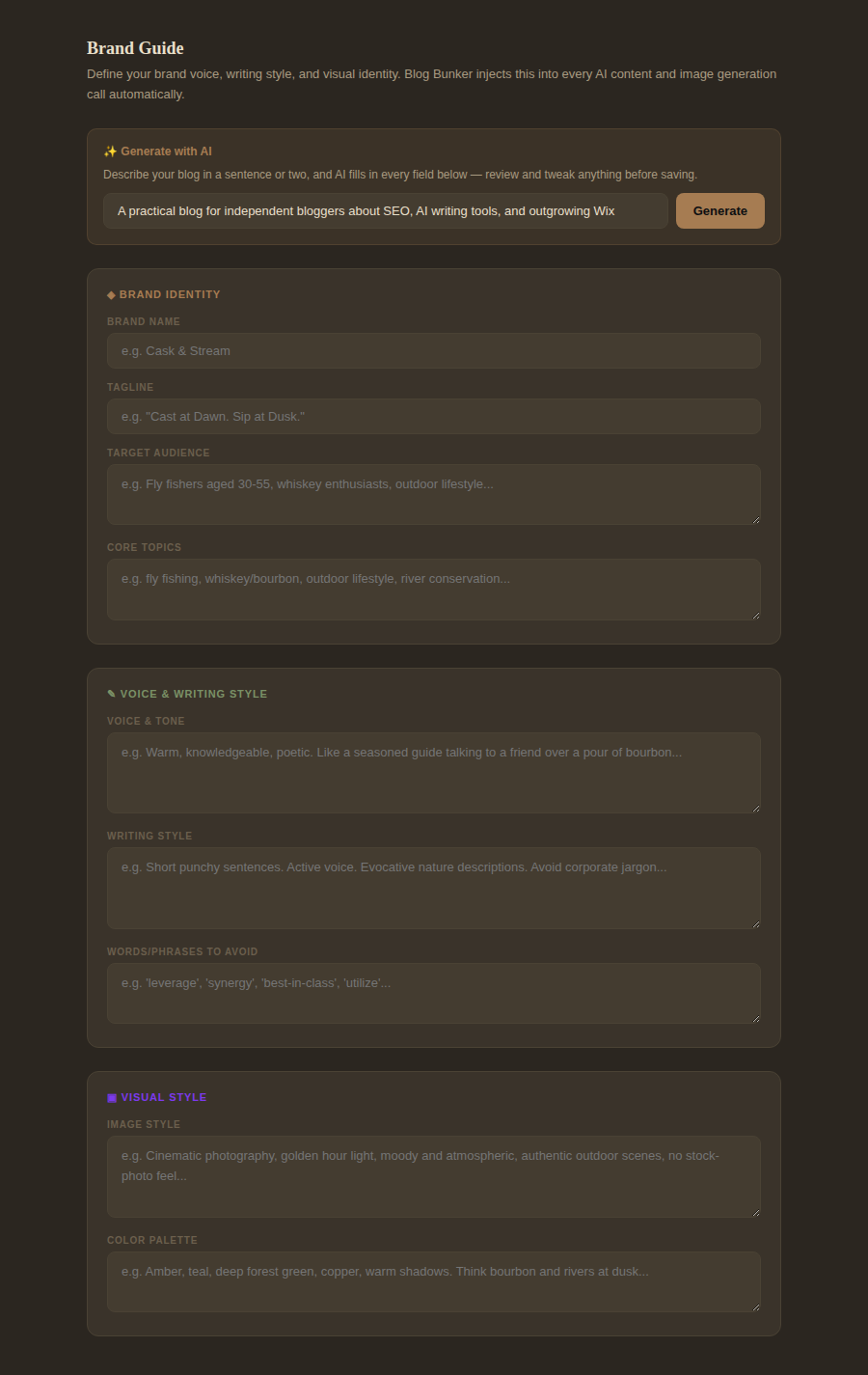
    This is your Brand Guide — it’s what lets the AI drafting sound like you instead of a generic AI voice. You’ve got two ways to fill it out:
    • The fast way: describe your blog in a sentence (“a fly fishing and whiskey blog with a laid-back, know-it-when-you-taste-it voice”) and click ✨ Generate with AI — it fills in your tagline, audience, topics, voice and tone, writing style, and more for you to review.
    • The manual way: fill in each field yourself if you already know exactly how you want it worded.
    Either way, you can always come back and refine this later from Settings — it’s not a one-time decision. blog-bunker-brand-guide-screenshot

    Step 3: Connect WordPress

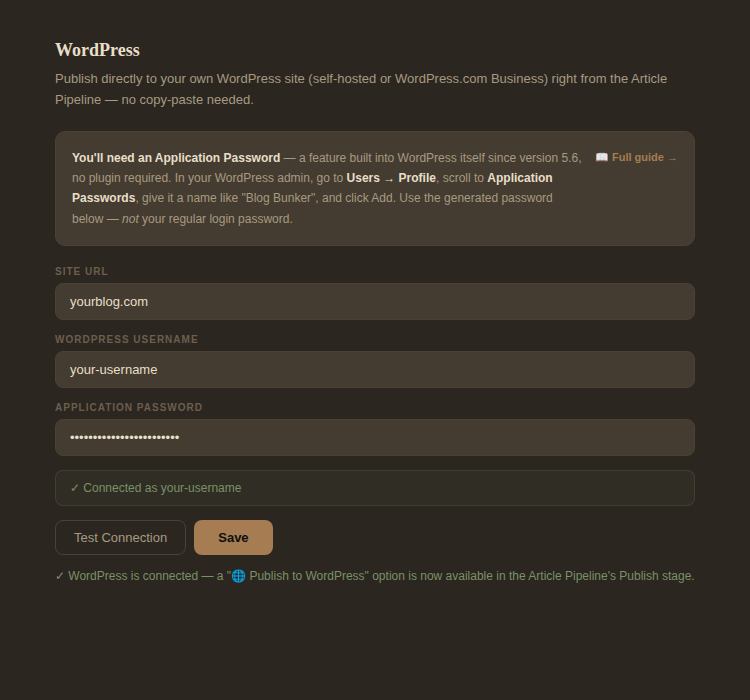
    If your blog runs on WordPress, this is where you connect it — and it’s genuinely the flagship piece of what Blog Bunker does, so it’s worth getting right up front. You’ll need a WordPress Application Password, not your regular login password. Here’s where to get one:
    1. In your WordPress admin dashboard, go to Users → Profile (or Users → Your Profile)
    2. Scroll down to Application Passwords
    3. Give it a name like “Blog Bunker” and click Add New Application Password
    4. WordPress will show you a password once — copy it immediately, you won’t see it again
    5. Paste that into Blog Bunker’s WordPress connection field, along with your site’s URL
    This is a real WordPress feature built into core — no plugin required. If you don’t run WordPress yet, or want to connect it later, you can skip this step for now. blog-bunker-wordpress-connect-screenshot

    Step 4: Choose your plan

    Your first month runs on Scout, completely free — no card required. Explore the real app before deciding on anything. If you already know you want Operative’s larger AI allowance and full channel lineup, you can pick that instead. blog-bunker-plan-selection-screenshot

    Step 5: You’re in

    That’s it — you’re looking at your dashboard now. A quick map of what’s where:
    • Blog — your Article Pipeline (where posts get written) and Research tools
    • Marketing — your Social Pipeline, Media Library, and Image Studio
    • Analytics — your Blog Health Score and performance
    • Calendar — everything scheduled, blog and social together
    • Settings — your Brand Guide, connections, and plan
    Next up: The Field Manual 02 walks through writing and publishing your actual first post, start to finish.
  • Ethical AI Publishing: The Raw No-BS Guide

    Ethical AI Publishing: The Raw No-BS Guide

    The screen glows in the dark of your workspace like an unblinking eye. It’s 2:00 AM. You have a blank document on one side and a list of ten high-intent keywords on the other. Your competitors—venture-backed digital media conglomerates with armies of fresh-out-of-college writers—are pumping out fifty articles a day.

    You are a crew of one, maybe two. You have a laptop, a coffee that went cold three hours ago, and a choice.

    Do you open a generative AI tool, type in a lazy prompt like “write a 1,500-word post about dry fly selection for autumn trout,” copy the vanilla output, and hit publish?

    If you do, you aren’t a publisher. You’re a spammer. And sooner or later, the search engine algorithms will find you, strip-mine your domain authority, and leave your site to rot in the forgotten pages of the index.

    At The Blog Bunker, we don’t run from technology, nor do we worship it. We treat AI like a tool—a sharp, heavy-duty chainsaw. In the hands of a professional who respects the blade, it clears a path through the dense forest of content production in record time. In the hands of a fool, it takes off a limb.

    This is the blueprint for mixing the raw horsepower of AI with the irreplaceable gut, sweat, and ethics of human-driven publishing.

    —

    The Ghost in the Editorial Room

    Let’s get one thing straight: AI is not a writer. It is a highly sophisticated, predictive autocomplete engine. It doesn’t know what a 12-year-old cask-strength Islay scotch tastes like. It has never felt the freezing bite of wading into a mountain creek at dawn, waiting for the hatch to start.

    When you ask an LLM (Large Language Model) to write from scratch, it pulls from the average of everything that already exists on the web. It delivers the middle of the road. It serves up lukewarm, corporate-approved paste.

    But as a research assistant, an outline engine, and a structural editor? It’s pure gold.

    The strategy is simple: Automate the logistics; dominate the perspective.

    You use AI to dig the trenches, but you do the shooting. This hybrid approach allows a solo blogger or micro-team to match the output of a ten-person newsroom without sacrificing the gritty, authentic voice that made your audience trust you in the first place.

    —

    The Rules of the Trench: Ethical AI Workflows

    If you’re going to deploy AI in your publishing stack, you need a code of conduct. Without one, your brand identity will dissolve into a sea of generic content.

    1. The “First-Hand Experience” Mandate

    Never let AI write about something you haven’t personally touched, tested, or tasted. If you are reviewing a fly reel or a bottle of rye whiskey, the core insights—the weight, the drag tension, the burn on the back of the throat—must come from your hands and your palate.

    Use AI to help you structure those thoughts. Input your raw, messy voice notes into the machine and prompt it: “Clean up these raw notes into a cohesive, bulleted list of pros and cons, retaining my specific observations.”

    That is ethical leverage. You aren’t fabricating expertise; you are streamlining its delivery.

    2. The Hallucination Hunt (Zero Trust Policy)

    AI models lie. They don’t do it maliciously; they do it because their primary directive is to be helpful and grammatically correct, not factual. They will invent historical dates, fabricate product specifications, and cite non-existent sources with absolute confidence.

    Every single fact, statistic, and quote generated by an AI must be treated as hostile until verified. If your AI outline states that a specific bourbon won double gold at the San Francisco World Spirits Competition in 2018, you do not publish that line until you have checked the official archives. One unverified lie can destroy five years of hard-won reader trust.

    3. Burn the Buzzwords

    You can spot AI-generated text from a mile away by its telltale tics. It loves words like testament, landscape, delve, foster, navigate, holistically, and moreover. It writes in passive, polite, and sterile structures.

    When editing AI-assisted drafts, keep a scalpel handy. Slice away the fluff. Replace passive sentences with active verbs. If the machine writes, “It is important to consider the water temperature when fly fishing,” rewrite it to: “Check the water temperature. If it’s above 68 degrees, pack up your gear and go home—you’re killing the fish.”

    —

    The 70/30 Hybrid Workflow

    To survive as an independent publisher, you must be efficient. Here is how we split the labor between human and machine to maintain a relentless publishing cadence without losing our souls.

    “` [Phase 1: Human (15%)] -> Strategy, unique angle, personal anecdotes, primary testing. [Phase 2: Machine (50%)] -> Outlining, semantic SEO analysis, rough draft expansion. [Phase 3: Human (35%)] -> Fact-checking, voice injection, line-editing, final polish. “`

    Phase 1: The Human Spark (15% of the time)

    Before you touch an AI tool, define your hook. What is your unique take on the topic? Why does the internet need another article about this? Example: Instead of a generic guide to “Best Rye Whiskeys,” your angle is “The 3 Best High-Rye Whiskeys That Actually Stand Up to a Bold Ginger Beer.” You select the bottles from your own shelf. You write down your raw tasting notes.

    Phase 2: The AI Draft Horse (50% of the time)

    Now, bring in the machine. Feed it your angle, your raw tasting notes, and your target keywords. Prompt: “Act as a veteran spirits writer with a gritty, direct, and authoritative voice. Use these raw tasting notes [Insert Notes] to construct a detailed draft. Focus on concrete descriptions, avoid corporate fluff, and structure the post with clear headers.”

    The machine will spit out a rough, 1,200-word draft in thirty seconds. It will be 60% of the way there.

    Phase 3: The Human Polish (35% of the time)

    This is where the magic happens. You take the raw clay of the AI draft and carve it into a monument.

    • Strip out the generic transition sentences.
    • Insert your specific, gritty anecdotes.
    • Check every product spec sheet to verify proof, mash bill, and price.
    • Read it out loud. If it sounds like a manual for a microwave, rewrite it until it sounds like a conversation over a campfire.

    —

    The Survivalist’s Verdict

    The debate is over. AI is here, and it is not going back into the box.

    You can stand on the sidelines, clinging to outdated, slow-producing workflows while the digital landscape shifts beneath your feet. Or, you can step into the bunker, grab the tools, and learn how to run them with precision and integrity.

    The future of digital publishing doesn’t belong to the giant media networks running automated content farms. Nor does it belong to the purists who refuse to adapt and get drowned out by the noise.

    The future belongs to the hybrids—the independent crews who use AI to build the scaffolding, but use their own blood, sweat, and whiskey-soaked wisdom to build the house.

    Command your niche. Play dirty, publish clean, and never let the machine do your thinking for you.

  • The Blog Bunker: A Community for Small Bloggers

    The Blog Bunker: A Community for Small Bloggers

    There’s a certain romance to it all—locked away in a quiet corner of the digital wilderness, we small bloggers are akin to hermits in a cabin. We spin words into webs, cast them out into the vast expanse, and wait for connection. Yet, navigating these digital waters isn’t always easy. From fluctuating analytics to invasive pop-ups, the challenges are a modern-day tempest. But, like a hidden eddy rife with fish, I stumbled upon a solution called The Blog Bunker—a refuge for the small blogger, where tales can be told and community thrives.

    The Overlooked Artisan

    If you’re a small blogger, you know the drill. We are craftsmen of sorts, with narratives etched like whorls in timber. There’s no hefty marketing budget, no legion of virtual assistants. Just our words against the wind. Often overlooked, we press on, fueled by passion for storytelling and a longing to connect with kindred spirits. The Blog Bunker feels like it’s whittled from the same rustic timber; it’s a place crafted for us by us, with tools tailored for our unique needs.

    Picture yourself stepping into a quaint workshop enveloped by the scent of pine and freshly ground coffee, where each tool has its purpose. That’s what The Blog Bunker promises—a digital sanctuary that brings focus to the artisan’s work away from the overwhelming bustling metropolis of mainstream blogging.

    Why We Need The Blog Bunker

    In a world swarming with bellowing influencers and digital giants, being a small blogger can feel isolating, akin to casting a line into an unyielding stream. Sometimes, our voices echo unheard amidst the cacophony. The Blog Bunker understands this solitude, offering a quiet camaraderie—a space to commune with fellow writers who don the same boots.

    It carves out a niche just for us: the woodworker’s bench free of frills, the flybox nestled within a handcrafted chest, the aged bourbon poured carefully under the glow of candlelight. It strips away the razzle-dazzle and focuses on what truly matters: the purity of the tale told and the shared experience.

    Simplifying Complexity

    Fly fishermen know that simplicity in tackle often brings the biggest catch. Fancy lures, for all their promise, can spook the trout away. Likewise, The Blog Bunker presents itself as a site devoid of unnecessary gimmicks—no glittering buzzers or smoke screens here. Instead, it hands you a well-worn rod, perfectly balanced, with all the essential tools you require for a good day on the digital creek.

    From seamless user interfaces to robust community support, The Blog Bunker simplifies the complexities of blogging. It provides an environment where content creation becomes less about deciphering SEO analytics and more about flipping open a moleskin to pen down genuine thoughts. Think of it as tying a simple yet effective fly; precision and purpose in every knot.

    Building Your Legacy

    A blog is more than just a website—it’s a slice of your legacy, a corner of the world where your values and voice breathe life. The Blog Bunker embodies the same ideals cherished by small bloggers and respects the integrity of their craft. Like the painstaking effort of hand-hewing wood into furniture, it recognizes that each post and photograph is a piece of art contributing to your digital heritage.

    And let’s not forget, for those of us reflecting on midlife’s journey, it’s a space that celebrates the quiet triumphs and acknowledges the wisdom found in our stories. It’s here where we remind ourselves that finding purpose doesn’t always come with fanfare; it’s the whispering creek at dawn, inviting introspection and connection.

    Stories and Spirits Shared

    The essence of a good night’s campfire storytelling—with companions passing around anecdotes and a bottle of stout bourbon—should be captured in the digital realm as well. The Blog Bunker fosters this ambiance. Conversations flow easily here, with everyone from seasoned sages to the bright-eyed novice sharing the warmth of digital fellowship.

    Much like a fly fishing guide, it navigates you through the riffles, ensuring each cast is met with opportunity, while the camaraderie lets the adventure be just as rewarding as the catch. You might even find yourself sipping on the perfect metaphorical dram of advice and encouragement when you need it most.

    Casting into the Future

    The Blog Bunker offers a reflection on the richness of life; casting where the water runs true is an act of faith and craftsmanship. For the small blogger, this sanctuary acknowledges our craft’s beauty and ensures our stories ripple far beyond our secluded creek.

    So, to the kin-brained storytellers of our digital age—let us retreat, regroup, and refresh at The Blog Bunker. There, by the fire’s edge, let’s cast together at dawn and sip our reflective draughts at dusk. And in doing so, we’ll keep the art of storytelling alive, ever resilient and resonant, just beneath the surface of the digital tide.

    In every post, in every shared story, we’re building more than a blog—it’s a legacy, whispered under stars and embedded in the hearts of those who find their way to our shores. Here’s to the untold tales and unseen glories. Where words are the catch of the day, and The Blog Bunker is our cherished haven.